
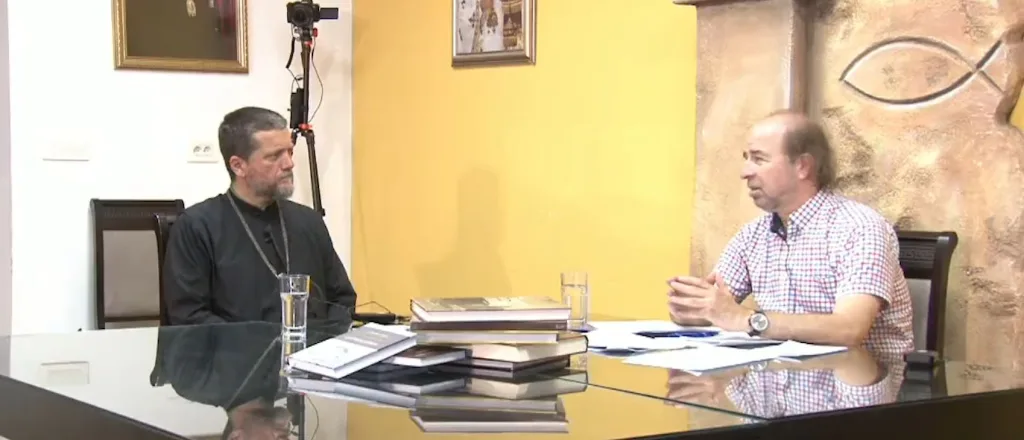
The Vidovdan ethics was the topic of a dialogue forum held in the parish hall of the Church of Saint George under Gorica. Numerous citizens, representatives of the academic community, and public life attended the discussion, where the spiritual values and their significance in contemporary society were addressed by priest Gojko Perović and university literature professor Dr. Goran Radonjić.
“Let me pose a simple folk question, are we normal for celebrating some defeats? So that is a classic question, and if we tried to answer that question, we would clarify a lot about what we celebrate when we gather on Vidovdan,” said priest Gojko Perović.
Professor Goran Radonjić stated that Vidovdan is one of the greatest holidays.
“Since it is one of the greatest holidays, it cannot be that we celebrate defeat. The very idea of our Kosovo vow, we will talk later about what the terminology could be, the idea is that it is actually a victory. A victory in the sense that on that day in 1389, on Vidovdan, a key and defining choice was made for our community between two empires,” explained Radonjić.
A special emphasis was placed on the literary and philosophical interpretation of tradition, highlighting its influence on shaping national culture and identity through different epochs.
Perović emphasized that it seems to him that today we could not have a view of the Kosovo vow without Njegoš as he was.
“The most terrifying password of the Serbian language that can be compared to the greatest expressions of world literature is that, let it be what cannot be. It is just as much Kosovo-vow as it is in its source New Testament, I believe in the impossible, I believe in Christ’s resurrection,” concluded Perović.
Radonjić believes that this is a contemporary view, but Njegoš is not anachronistic and he is the most modern man of his time.
“I see this in his education, his horizons, his way of writing, but also the fact that he is the most modern simultaneously means that he paid attention to tradition and gave his interpretation of that tradition. This applies to Andrić, Vasko Popa, Miodrag Pavlović, and all our poets,” explained Radonjić.
Such discussions, as the organizers of the forum add, represent an opportunity to reflect on historical themes from different angles, with a dialogue that connects spiritual, cultural, and literary heritage with the challenges of contemporary times.



Comments