

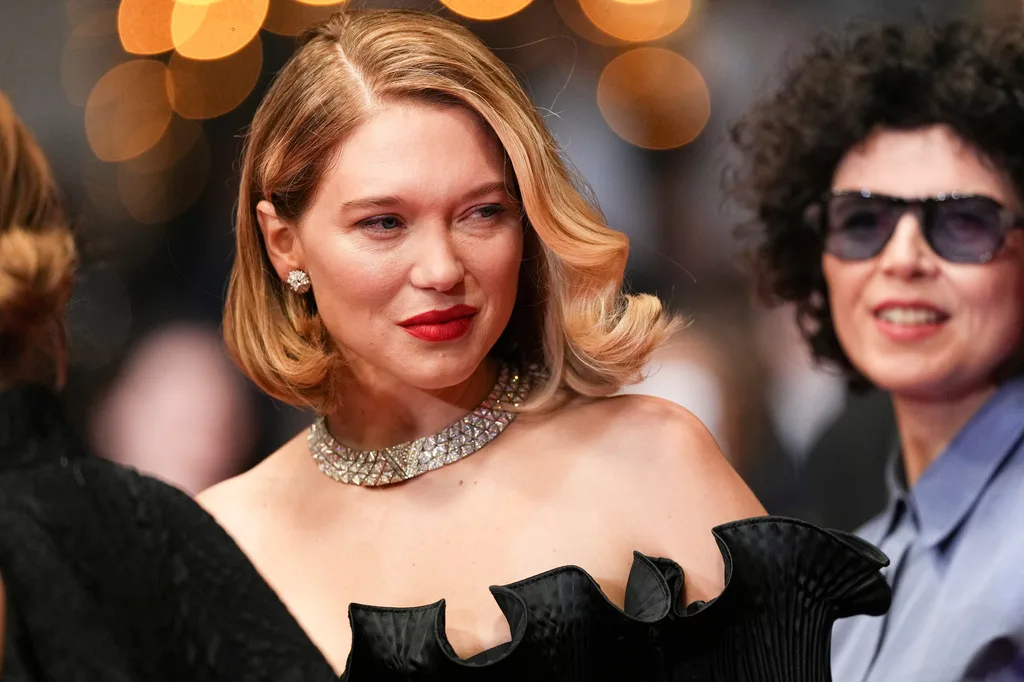
This year, she took on leading roles in two original works in the main competition program at Cannes: in the body-swap mystery „The Unknown“ („L’Inconnue“) by Arthur Harari (who deserved an Oscar for Best Screenplay for „Anatomy of A Fall“ in 2023, shared with co-writer and director Justine Triet) and „Gentle Monster“ by Austrian director Marie Kreutzer („Corsage,“ which earned Vicky Krieps the Cannes award for Best Actress in the „Un Certain Regard“ competition program in 2023).
Both films left empty-handed in May, despite being frequent subjects of analysis and discussion. The former was noted for its interesting mix of thriller, drama, and one of the popular genre themes, while the latter was discussed for its very confusing script and plot in which a seemingly harmonious family experiences extreme upheaval when it turns out that the husband (Lorens Rup) is a pedophile. Or is he?
Kreutzer complicated the story by using the physicality of her actress in a similar (though not quite so explicit) way, portraying the married couple as intimately close, with one single scene that might eventually lead the viewer to think that something is wrong with the husband. However, not every viewer from every nation might think so. For many, nudity (even in the household) is quite a natural thing.
„L’Inconnue“ was the topic of an exclusive conversation with the great French star, and for one completely non-filmic detail. Since filming began just two months after the birth of her second son, Seydou appears in a much fuller shape than we are used to.
„Objective“ thus had the opportunity at Cannes to talk with Seydou about both films, in two different sessions, so this text „melds“ both.
OBJECTIVE: Let’s start with the question – what would you say about the challenges posed by Harari’s script for „The Unknown“?
SEYDOU: He didn’t want any special effects, which really posed a big challenge considering the types of films with such themes we are used to watching. Since there were no special effects or „tricks,“ it was particularly interesting for me because I had to „invent the wheel“ and imagine that struggle between the psyche and what the mirror reflects. Since the plot is completely fictional, pure fantasy, I wanted to make my character believable. And there is very little dialogue in the film, so a lot had to be expressed through pure physical performance.
OBJECTIVE: Do you consider your body a good instrument for acting?
SEYDOU: Oh, absolutely! If you ask me, everything comes from the body. Emotion is something that „hits“ you when you can’t express something with words or music. So I try to express everything physically. And that’s why my body is the right instrument, and from there everything flows.
For example, in „Gentle Monster,“ it was important for me that Lucy be somewhat grounded. I wanted her to be very reliable and to have a kind of tangible presence. And the physicality we are talking about is essential to approach that emotional tsunami she goes through, and to push forward for the sake of her son. She finds herself in a situation where she is, in a way, in a moment of moving on – and fighting for her son. She wants to protect him, and she is in a state of emotional war that she does not express externally, but maintains a facade and increasingly holds onto music as a form of self-therapy.
As for „The Unknown,“ it was the first time I explored my body in a different way, as I had just become a mother. I freed myself from the pressure of certain expectations about how a naked actress should look on screen, and although I was far from how people usually know me, I did not feel uncomfortable. It was a completely new experience.
OBJECTIVE: What prompted you to accept, to put it mildly, an uncomfortable role in „Gentle Monster“?
SEYDOU: It’s a very important topic, and I also liked that it’s impossible to immediately draw absolute conclusions. In „Gentle Monster,“ you cannot make direct judgments, and I think films should not be overly moralistic because they speak about the human condition. So, I love that Marie Kreutzer chose to tell the story from the perspective of the wife who is not portrayed as collateral damage. And so, the fact that the story unfolds through her perspective was very interesting for me because it contributed, with its complexity, to understanding the whole contradiction and ambiguity she goes through.
There are mixed feelings: first, she doesn’t want to believe what is happening, then she is in denial because she loves her man. There are different levels present: the shame she feels and the secret she actually cannot talk about, because it is impossible to open up to people about something like that. The fact is that she is completely isolated in a foreign country whose language she does not speak and does not know all the codes of communication. Everything happening to her in a foreign country makes things even more chaotic. And that’s why I thought it was very interesting that Marie chose to tell the story through this woman and about the denial she goes through, because the fact is that you cannot stop loving someone with the simple push of a button. As an audience, you, in a way, tend to empathize with the monster because you are with him.
OBJECTIVE: Is it possible to love a monster?
SEYDOU: We empathize more with her than with the husband, who is a mysterious figure in the film. And we also have no idea what actually happened until the end. And we will never know. When we talk about dramatic and relevant events, I think it is necessary and more interesting to talk about them from the perspective of someone close to the problematic person, but from her perspective. And because of that, we develop more empathy with her, but at the same time feel that she has those contradictory emotions.
OBJECTIVE: Still, there is never a feeling that Marie wants us to develop empathy for the monster…
SEYDOU: That’s true. There is no empathy for him. He is in a state of emotional drunkenness, and we do not feel how he functions. Everything is on the woman. Through her, we get the emotions.
OBJECTIVE: What happens in „The Unknown“ is also a kind of monstrosity…
SEYDOU: But of a completely different nature over which a person has no control. Souls wander from body to body, and the concept of losing a part of yourself is quite frightening. A „lost body“ that you cannot find and a forever lost connection with the natural environment. In that situation, a person is in a continuous process of questioning identity. From day one, I told myself that I am David, so I didn’t even try to play a man in a woman’s body, but simply him. The film raises the question of who we are in a way that provokes nausea in the stomach.
OBJECTIVE: „Gentle Monster“ was filmed on locations in Germany and Austria…
SEYDOU: Yes. We filmed in many locations in both countries. In Munich, and in beautiful places in the Austrian mountainous region with a lake. In the film, we talked about Styria, but we weren’t there, rather near Salzburg.
OBJECTIVE: And regarding the different languages, how did that sit with you?
SEYDOU: Phenomenal. I loved the opportunity to embrace that option.
OBJECTIVE: Accordingly, it is a very European co-production. Do you think something like that is necessary to break geographical boundaries in terms of audience?
SEYDOU: I had the opportunity to work with many different directors from different countries, which gives me the chance to travel and meet different cultures. And with all my previous experiences, I understand that film also represents a universal language. In cinematography, it is about the human condition, which is a very interesting way to question everything. And fundamentally, and now I speak from a personal perspective, I think it is wonderful to travel and meet people from other cultures, which is fascinating. Film has offered me the chance to understand that better, that my engagement with the directors I have worked with had its own language, and the way they grappled with difficult themes.
OBJECTIVE: What does that specifically mean in „Gentle Monster“?
SEYDOU: I don’t know, but the feeling was good.
OBJECTIVE: Do you play the piano privately?
SEYDOU: I love music, but before filming the movie, I didn’t know how to play the piano, so I had to take private lessons. I learned a couple of performances, and as for singing, I have always enjoyed doing that. However, I didn’t have the opportunity to end up in some cult musical like Catherine Deneuve.
So, for „Gentle Monster,“ I practiced with Kami (a French singer and composer, Oscar winner for Best Original Song in the film „Emilie Perez“ by Jacques Audiard in 2024), who is an extraordinary artist. And that is a great honor because I am a big fan of hers.
OBJECTIVE: Were you familiar with Marie Kreutzer’s films?
SEYDOU: Yes and no. Previously, I had acted in only one Austrian film directed by Jessica Hausner („Lourdes,“ 2009). This role was originally intended for an American actress. For some reason, that plan changed, so when they offered me the role, everything remained the same except for the change in the nationality of the heroine. I am a French woman in the film who speaks English and German. What is typically Austrian in the film is that feelings are not discussed directly, meaning – they are never in the foreground. Everything is covered with a layer of makeup, if you understand what I mean. People swallow their emotions and keep everything inside. Subtle mystery.
OBJECTIVE: Is that perhaps the reason why you are also mysterious in your role?
SEYDOU: Yes, because that is the way the character is written. I have also played some other roles where people are not subtle at all, like, for example, France in the eponymous film by Bruno Dumont („France,“ 2021), where I was a very extroverted kind of person, which was also interesting. But, this kind of role suits me as well.
OBJECTIVE: Everyone is talking about how Adèle Exarchopoulos arrived in Cannes wearing a „Love, Lea“ t-shirt. But you also have a similar shirt paying homage to her, don’t you?
SEYDOU: Yes, yes, I wore mine before hers. We have ways of greeting each other. So to speak, we wink at each other since we are both in the competition program this year, so we support each other. In fact, we have always supported each other. I am a big admirer of hers and I really appreciate the choices she makes. She has developed in a very good direction.
OBJECTIVE: „Gentle Monster“ opens with a scene in which you sing the song „Would I Lie To You,“ whose lyrics are suggestive. „Everyone wants to know the truth“ is part of one of the verses…
SEYDOU: She may want to know the truth, but it is more likely that she subconsciously fears it. But, let’s not forget that at that moment „everything is fine“ and that it is a very well-known, popular song that many have covered. And it is about lies, not about truth.
OBJECTIVE: Have you thought about a parallel music career?
SEYDOU: Oh, no. I don’t believe I could be a singer because I am shy about performing in front of an audience.
OBJECTIVE: Didn’t you say the same about acting?
SEYDOU: Yes, but as an actor, you can hide behind the character you are portraying. In singing, there is no filter between you and the audience. Interestingly, shyness does not fade over time, and I actually love that about myself. It is also not something one can decide, it just is what it is. I am shy, but I don’t think that’s so bad. I try to protect the child within me as much as possible.
OBJECTIVE: How was it working with Catherine Deneuve?
SEYDOU: It was a dream come true. I adore her in Jacques Demy’s films, but she has starred in so many legendary works. With Buñuel, Truffaut, I even love her in Lars von Trier’s „Dancer In The Dark“ (2000). And she is also shy in many ways, but so are many people; it’s just that we all have different manifestations of shyness.
OBJECTIVE: In recent years, you have mostly acted in European films in French. Is that a conscious choice?
SEYDOU: I have no idea. It’s not something I think about. I make films that I want to watch, and I consider myself lucky to be a European actress. I think Hollywood films are not very performative because you have to satisfy the industry in a way that Europeans do not have to. I also act in independent, smaller productions. But it’s not that I haven’t had big films. There have been a few. Perhaps the right answer is – freedom. This way I feel freer.








Comments