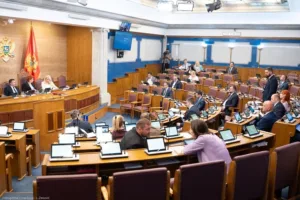

In other words, an MP earned almost four times the average salary. Even more dramatic was the relationship with the minimum wage of 193 euros – at that time, an MP's salary was almost ten times higher.
It was a period when the political class was rightly described as a privileged caste, divorced from the economic reality of the citizens. Nine years later, the picture is significantly different.


According to data for 2025, the average net salary in Montenegro increased to 1,022 euros, while the average salary of an MP reached 2,092.20 euros. At first glance, this is still a high salary, but the key is in the ratios: the MP's salary is now about twice the average salary, which is half the gap compared to 2016.
The change is even more visible when looking at the minimum wage. Today's minimum wages of 600 and 800 euros have significantly reduced the gap — a member of parliament's salary is now about 2.6 to 3.5 times higher, depending on the category of minimum wage. Compared to the previous ratio of almost 10:1, this represents a fundamental shift.
It is also important to distinguish between basic and total MP earnings. The average basic net salary of MPs in 2025 is €1,677.22, which is only about 1.6 times higher than the national average. This further relativizes the perception of “huge” MP earnings, as a significant part of the difference comes from job-related allowances, not the base salary itself.
The trends in the graphs clearly confirm this process: while MPs' salaries grew relatively steadily, wages in Montenegro — especially after the minimum wage reforms — grew faster, thus systematically narrowing the gap. Even the wage ratio graph shows a drop from around 370% of the average salary to around 200%, which is a historical minimum in the observed period.
This data does not mean that MPs are poorly paid — on the contrary, they are still above average, which is to be expected for the highest legislative positions. But it does mean that they are no longer isolated from the society in which they live, nor do they represent an extreme in the salary system.
Ultimately, the narrative of “overpaid politicians” no longer holds up to the same extent as it did ten years ago. Today, it is more realistic to talk about the normalization of salary ratios, where differences are still present, but are no longer dramatic or socially unsustainable.
And that is perhaps the most important change: MPs are no longer a symbol of privilege, but part of a broader economic framework that – at least when it comes to earnings – has finally become closer to citizens.