
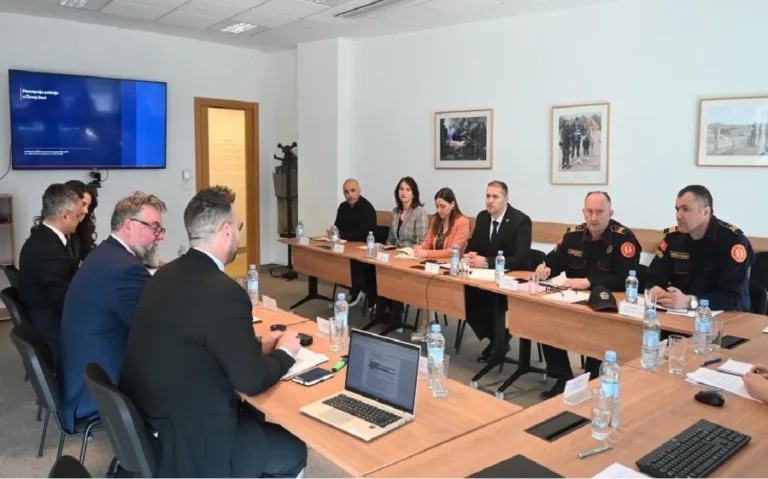
These are some of the key findings from this year's research, commissioned by the OSCE Mission to Montenegro and conducted by the Damar Institute. The results were presented to the Director of the Police Administration, Lazar Šćepanović, and representatives of this institution at an event organized at the premises of the Mission, in the presence of the Head of the OSCE Mission to Montenegro, Ambassador Jan Haukaas.
"Respondents cited organized crime (56%), drug addiction (55%), drug trafficking (52%), followed by corruption (49%) and murder (46%) as the main threats in 2025. High levels of concern were also recorded for domestic violence (44%), economic crime (42%), peer violence/school safety (41%) and traffic safety (38%)," the OSCE said.


This year's survey brings a slight improvement in the perception of the fight against organized crime, while the perception of the influence of criminal groups on police work recorded a significant decline of 27% compared to 2023.
"When it comes to firearms ownership, the majority remains opposed to firearm ownership (86%), and the attitudes of respondents over the period have shifted towards stronger support for the legalization of unregistered firearms - where there is a legal basis for possession. Compared to the previous year, satisfaction with police activities to suppress violations of the Weapons Act was highlighted, which recorded an increase of over 8%," it states.
The Mission has been supporting research on police perceptions for several years, generating evidence-based insights to improve police-community relations and inform policing reforms. The latest findings highlight strong public support for closer cooperation between police and communities in crime prevention.
During the meeting, the Analysis and Recommendations for the Implementation of Community Policing, prepared by an expert engaged by the Mission, was also presented. Building on the strong public support for joint police-community action highlighted in the research, the Analysis outlines practical steps to strengthen community policing in Montenegro.
"The analysis addresses several key thematic areas, including the training and professional development of police officers, the employment structure, officer motivation and communication strategy. It provides recommendations to support the Police Directorate in further developing a modern, community-oriented model of policing that places a strong emphasis on crime prevention and partnership with citizens," it explained.
The presentation of the research and analysis provided the Mission and the Police Directorate with an opportunity to discuss key findings and identify areas where joint efforts can be further strengthened.