
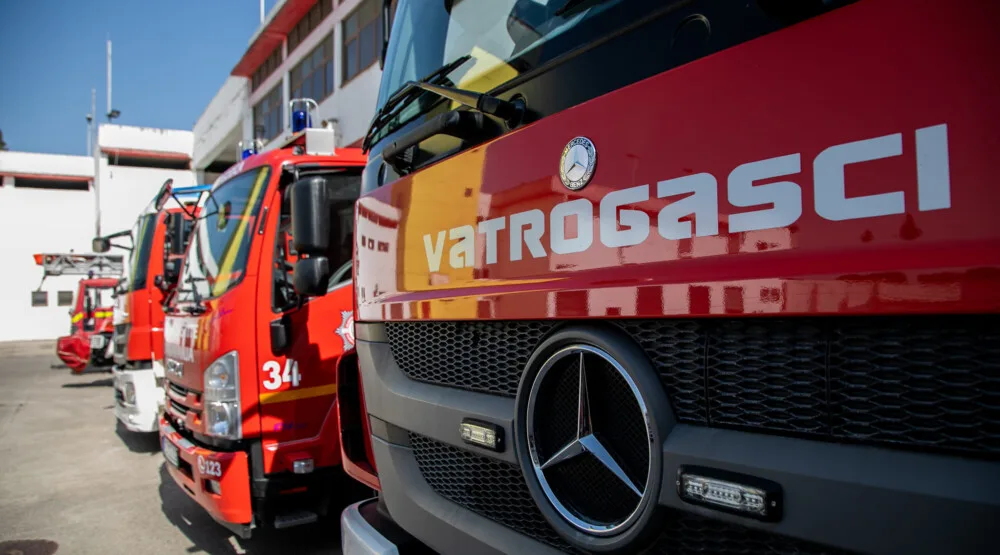
The Capital City Protection and Rescue Service is ready to meet all challenges, especially in the run-up to the summer season when the risks of fire and other emergencies are most pronounced. As the service points out, preparations are continuous and comprehensive.
"The Capital City Protection and Rescue Service is ready to respond to emergencies and is preparing especially intensively before each summer season, when the risks are greatest. Through increased activities, training, equipment checks and operational plans, we strive to ensure maximum readiness," the Service states.
They particularly emphasize the importance of coordination between all relevant entities, but also the realistic limitations in the most difficult situations.
"In the previous period, the coordination of all entities of the protection and rescue system has been further improved, which is crucial in complex situations. However, in extreme scenarios, such as those that occur in developed countries, no service can respond to all challenges alone without broader support from the system," they point out.
Climatic conditions represent one of the biggest challenges they face in the field.
"The biggest challenges are climate conditions, high temperatures and increasingly long dry periods, which directly increase the risk of fires," the Service explains, adding that an additional problem is the rapid development of the city, as well as the neglect of rural areas.
Although the system has been significantly improved, there is still room for further development.
"The protection and rescue system has been significantly improved compared to the previous period, both organizationally and in terms of equipment and readiness. Of course, there is always room for further progress, especially when it comes to modernizing equipment, strengthening preventive activities and further training of personnel," they say.
Speaking about staffing capacities, they state that the current number of employees allows for efficient work, with additional reinforcements during the season.
"The current number of members of the Service allows for regular tasks to be performed with quality and to respond to every type of intervention. Before each summer fire season, seasonal workers are also hired, in accordance with needs," the Service says, noting that the development of the city imposes the need for further strengthening of capacities.
When it comes to speed of response, the standards are clearly set.
"Our standard is to respond within two minutes of receiving the call," they emphasize, adding that the time of arrival at the scene depends on factors such as traffic and distance, but that the fastest route is always sought.
Forest fires today, they point out, are a more serious problem than before, and the causes are most often related to the human factor.
"Primarily due to climate change and long dry periods. There is also a pronounced trend that the population is increasingly gravitating towards the city, while rural areas and villages remain neglected, which further increases the risk of fire due to unmaintained areas. In most cases, the cause of fire is the human factor, while natural causes are much rarer," they say.
When it comes to equipment, the Service says that it is continuously being improved.
"The Service has modern equipment and it can be said that the Capital City is continuously investing in its improvement. In the previous period, a modern ladder truck was purchased, which significantly improved the possibilities of action in urban interventions. The Service is also purchasing personal protective uniforms intended for forest fires, which represents a major step forward in terms of safety and efficiency in the field. In addition, investments are being made in specialized equipment and vehicles, as well as in strengthening the overall capacities of the Service. In general, it can be said that the situation is improving significantly from year to year and that working conditions and equipment are at a high level," the Service points out.
Finally, they emphasize that prevention is key when it comes to fires, but also that criminal policy must play its role.
"We believe that in this area the most important thing is to focus on preventive measures, education and raising awareness among citizens. However, in situations where preventive measures do not yield results, it is necessary to act repressively through the application of legal penalties," the Protection and Rescue Service concluded.
J.B.
Comments