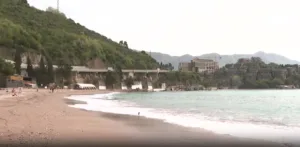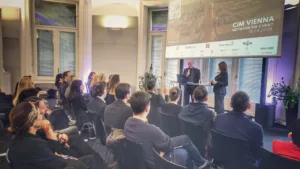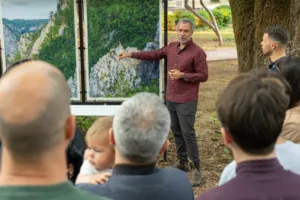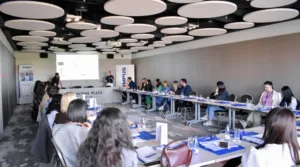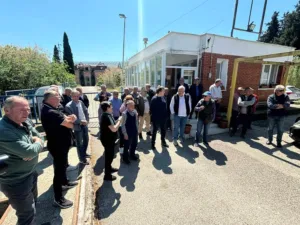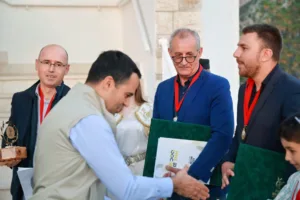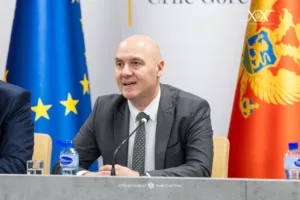

With a view of Old Bar and the Adriatic Sea, from the House of Olives, messages were heard about the importance of projects like this in connecting communities, true opportunities in tourism, the importance of environmental preservation, but also authentic local products and experiences.
President and Lead Manager of the Cluster Center for Tourism Development Željka Krivokapić-Milićević thanked the participants for their arrival and words of support. She emphasized that the idea of the project "Improving the Sustainability of Tourism Development in Montenegro" arose from the essence of Montenegro, which is not only, as she emphasized, a destination, but also a country of wild and preserved nature, a small but special people of good intentions and sincere hospitality.
"A country with an average of 270 sunny days a year, where the sea, mountains, rivers, lakes and hills meet at a short distance, and where every guest is not just a visitor, but is welcomed as part of the family. Its long tradition, rich cultural heritage, exceptional climate, organic production, but also its multiethnic and multiconfessional value form the basis of an authentic tourist product," Krivokapić-Milićević pointed out.

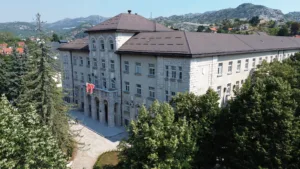
She expressed special gratitude to her colleagues from the Institute for Development and International Relations in Zagreb who were prevented from coming due to bad weather in Croatia. Croatian Ambassador to Montenegro Veselko Grubišić spoke about that country's experience in tourism. He said that it was a special honor for him to be back at the House of Olives in Stari Bar.
Speaking about his country's experience, he stressed that the real opportunities in tourism will only come after Montenegro joins the European Union. Since becoming an EU member, Croatia, Grubišić pointed out, has doubled its GDP last year to more than one hundred million. For tourism to continue on an upward path, Grubišić says, diplomatic promotion and cooperation are important.
"There is no more important policy for Croatia than benevolence. In these difficult times, we need to be gentle with each other. We share a historical and cultural heritage with Montenegro. Both countries preserve a rich natural heritage - from the coast to the mountainous regions. The tradition of olive growing, viticulture, seafaring... testifies to connections and common roots, the exchange of knowledge over time," emphasized Grubišić, adding that both Croatia and Montenegro share strategic goals, challenges and opportunities in tourism.
Slovenia's ambassador to Montenegro, Bernarda Gradišnik, spoke about Slovenia's experience in developing sustainable tourism.
"Sustainable tourism in Slovenia is based on the green scheme of Slovenian tourism. One of the best examples is Vohinj, where instead of the chaotic development of large tourist facilities, existing buildings are renovated, natural resources are managed in a way that minimizes waste, and renewable energy sources are used," said Gradišnik.
She emphasized that tourism in itself is not sustainable, but becomes so when it is planned and measured based on clear standards and data.
Šefko Kurpejović spoke on behalf of the Ministry of Regional Investment Development and Cooperation with NGOs.
"This gathering comes at an important moment, at a stage when the results are being summed up, but it also opens up space for its further application in this and next year. I would especially like to emphasize that sustainable tourism is not just a matter of environmental protection and improving the offer. It is a powerful instrument for the balanced development of Montenegro. Therefore, we welcome initiatives that strengthen the local economy and create an authentic and sustainable tourist offer," said Kurpejović.
The importance of connecting youth and sports with tourism was pointed out by Darko Stojanović, Director General of the Directorate for Youth and Cooperation with NGOs in the relevant ministry.
"Talking about tourism from a sports perspective may be a little different, but I can share the satisfaction that Montenegro has a trend of organizing sports competitions. People from abroad come then. This makes a special contribution to the development of the tourism industry in Montenegro. Where can you find better promotion than through sports and youth," said Stojanović.
Marko Gošović, Director of the Directorate for the Development of Creative Industries at the Ministry of Culture and Media, says that culture is an important promoter of tourism.
"The answer lies in cultural heritage, tradition, the language of space. Without culture, there is no sustainable tourism. Cultural heritage is not an object of protection, but an active resource for development. We are in a moment that requires us to view tourism not as a transient branch, but as a continuity. Such projects are confirmation that it is possible to plan strategically and achieve results," Gošović pointed out.
Olivera Blagojević, Director General of the Directorate for Tourism Destination Development and Strategic Planning at the Ministry of Tourism, pointed out that the positive figures from the World Travel and Tourism Council also speak about Montenegro's success as a tourist destination. In order to continue this trend, she explained, in light of the current crisis in the Middle East, it is important to work on the sustainability of the tourist destination.
"Our goal is quality, year-round sustainable tourism that benefits local communities and positions us as a responsible destination. We believe that this project is one of the tools that leads us towards that goal. Direct contacts, the development of opinions, ideas, are of particular importance. Diplomacy can do a lot when it comes to tourism, but we are also ambassadors of our country and we represent it best in this way," said Blagojević.
The gathering at the House of Olives was also organized by participants from the Chamber of Commerce, on whose behalf Anđa Vukčević-Zorić spoke, representing the Tourism and Hospitality Association.
"Tourism is one of our most important industries, whose future depends on our ability to develop tourism in a sustainable way. That is why these projects are important. Sustainable tourism is not only about preserving resources, but also about strengthening the authenticity of the offer and destinations," Vukčević-Zorić pointed out.
And, sustainable tourism is also about preserving the tradition that is in the hands of craftsmen, points out Jelena Spasova, executive director of the Chamber of Crafts of the Republic of North Macedonia.
"Tourism today is not just an industry, but a bridge between traditions, cultures and people. Authenticity cannot be imagined without crafts. They are stories passed down through generations and a mirror of history and creativity. The future of tourism is not only in large investments, but also in their people, stories, in their hands and knowledge. It is precisely artisans, people with disabilities, women from rural areas who have something to offer. We just need to lend them a hand," Spasova emphasized.
An important link in sustainable tourism is a satisfied accommodation provider, so Branka Džoganović, director of the Center for the Development of Private Accommodation, spoke about the challenges in their business.
"Sustainable tourism begins in the mindset of the host. He is the true creator of the experience, not the bed renter. He must have the support of the system, he must have an institutional framework that he must follow in order to be up to the task. Sustainable tourism is an economic, social and cultural balance. The problem is not whether we have guests, but whether we have a clearly defined offer. Sustainable tourism is not something that can be waited for. It is built," said Džoganović.
One example of how sustainable tourism is built is the Gea Retreat project, which was spoken about by founder Anđela Đokić.
"This is a project that deals with sustainable development depending only on nature. It started with the idea that it is important to actively restore nature. It is a refuge based on the natural principles of regenerative tourism. Giving nature more than we take," explained Đokić, adding that the retreats focus on digital detox, being present in the present moment, and connecting with yourself and nature through, for example, walking barefoot and thus connecting with the earth and nature.
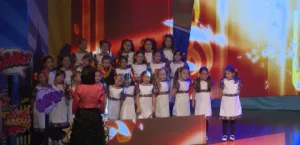
The ceremonial conference was accompanied by a cultural and artistic program by the Rumija Cultural and Artistic Association and the Petar II Petrović Njegoš Public Institution of Music and Drama. The gathering was accompanied by an exhibition of paintings, a presentation of cultural heritage and a mini-fair of organic products. Participants also enjoyed local flavors and the refreshment of local gastronomy.