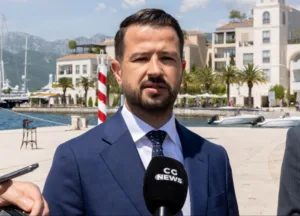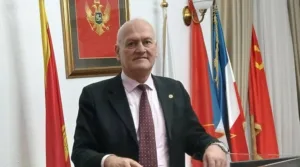
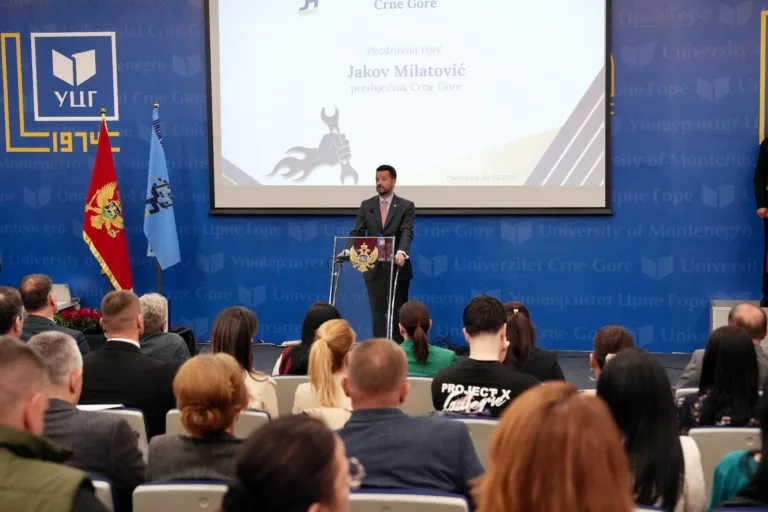
In the introductory part of his address, he recalled the historic struggle for workers' rights and the universal principles that emerged from it.
"More than a century ago, workers in large industrial cities fought for what is now the standard and rule: eight hours of work, eight hours of rest, and eight hours of life. In that one sentence, the great struggle of the modern world was summed up."
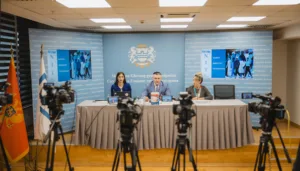
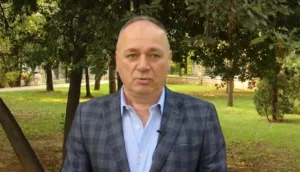
He also pointed out the fact that Montenegro also had its own authentic tradition of worker organizing and fighting for justice.
"Montenegro also had its own struggle. In Cetinje and Rijeka Crnojevića, in Bar, May 1st was not waited for because it was a non-working day, but rather workers organized themselves, fought for their rights and justice."
Recalling the social circumstances of earlier periods, he pointed out that awareness of the need for a more just society existed even without a developed industrial base.
"In the pre-war period, when Montenegro did not have large factories and thousands of workers under chimneys, there were craftsmen, printers, teachers, workers, young people who understood that a more just society cannot be waited for with folded hands. After the war, generations of our parents and grandparents built the country with their own hands. Schools, health centers, roads, railways, factories, entire municipalities were raised from the ashes. There is more truth about Montenegro in that picture than in many of today's discussions. When work is respected, the country is built. When work is underestimated, the state begins to empty."
He placed special emphasis on the contemporary challenges facing workers and the need to ensure a dignified life.
"Today we are not fighting for the same rights as a hundred years ago, but we are fighting for the same thing: that one can live peacefully, honestly and with dignity from one's work. That one's salary does not disappear before the end of the month. That Sunday is not just another working day. That the law is not one thing on paper, and another in the store, hotel, construction site or office. That a young man does not have to leave Montenegro because he sees only insecure work and expensive rent here."
Speaking about the institutional framework, he emphasized the importance of regulating labor relations through dialogue and agreement between all relevant stakeholders.
"The general collective agreement brings that story down to concrete terrain. It is an agreement on what work looks like in our country. Unions, employers and the state have different interests, but the same task: to create rules that bring security to employees, predictability to employers and order, which is most important in the country."
He specifically addressed the issue of Sundays as an important social value.
"The Sunday off is the second great lesson of our time. Once the fight was to prevent the workday from lasting from dawn to dusk. Today it is a fight to prevent the market from swallowing up the last day together of a family. This is not a question of ideology. This is a question of dignity and solidarity. The proposal to regulate the Sunday off as a constitutional category returns this issue to where it belongs: in permanent rules, with clear exceptions where work is truly necessary."
In his further presentation, he pointed out the economic pressures that affect the daily lives of citizens.
"At the same time, we must not turn a blind eye to what citizens experience every day. Prices that are rising. A salary that seemed higher yesterday is worth less today. Statistics can say one thing, but we know what is left in the wallet when food, fuel, medicine and rent are paid. The state must not behave as if high prices are a weather disaster. Inflation is not rain that will pass by itself. It is a blow to the standard of living and is responded to with measures, control, competition and protection of those who are most affected by the crisis. Likewise, someone must be responsible for the fact that our economy is slowing down and that growth last year was the lowest since the restoration of independence, not counting the three years of recession."
The President also emphasized the need for consistent application of the law and protection of workers and honest employers, and stressed that there should not be two labor markets: one in law, the other in reality, one for television stations, the other for workers who suffer injustice through blackmail.
"Inspections must finally be faster, more decisive and fair. An honest employer must be protected from unfair competition, and an honest worker must be protected from abuse. Rules that do not apply equally to everyone are nothing but anarchy, and we, unfortunately, live in anarchy."
In conclusion, the President pointed to the broader social importance of work and its key role in the future development of the country.
"May Day forces us to look at the present. What kind of a country are we building if a person works but cannot live from his work. What kind of a European future do we promise if in that future the worker remains on the margins. If Montenegro wants to truly be a well-ordered, solidary and economically strong country, the position of workers must be aligned with the standards and practices of the European Union. The success of a country is not only when the gross domestic product grows. Success is when a mother knows that she will receive her salary on time. When a father knows that he can be with his children on Sundays. When a young professional knows that he can advance here without party ties. When a worker knows that the law stands behind him, and not just good will."
The President reminded that once upon a time, the country was built with bricks, stones and railroad tracks, and that today it is built with a contract that protects the worker and the employer, a rule that protects the family, a measure that protects the standard and an inspection that never turns its back. In this sense, he emphasized that an agreement on the General Collective Agreement, a permanent solution for Sunday off, serious protection of living standards from inflation, faster economic growth and stronger control of labor rights are not a list of nice wishes.
"It is someone's job and responsibility, and the obligation of a state that understands that without dignified work there is no stability, no development, and no European future."
He concluded his speech by saying that on May 1st, we are not just celebrating work. "We are celebrating a man who protects his family, builds his municipality and keeps the country on its feet with his work. If that man does not have security, Montenegro does not have it either. If that man has dignity, then there is dignity in Montenegro as well," concluded President Milatović.