
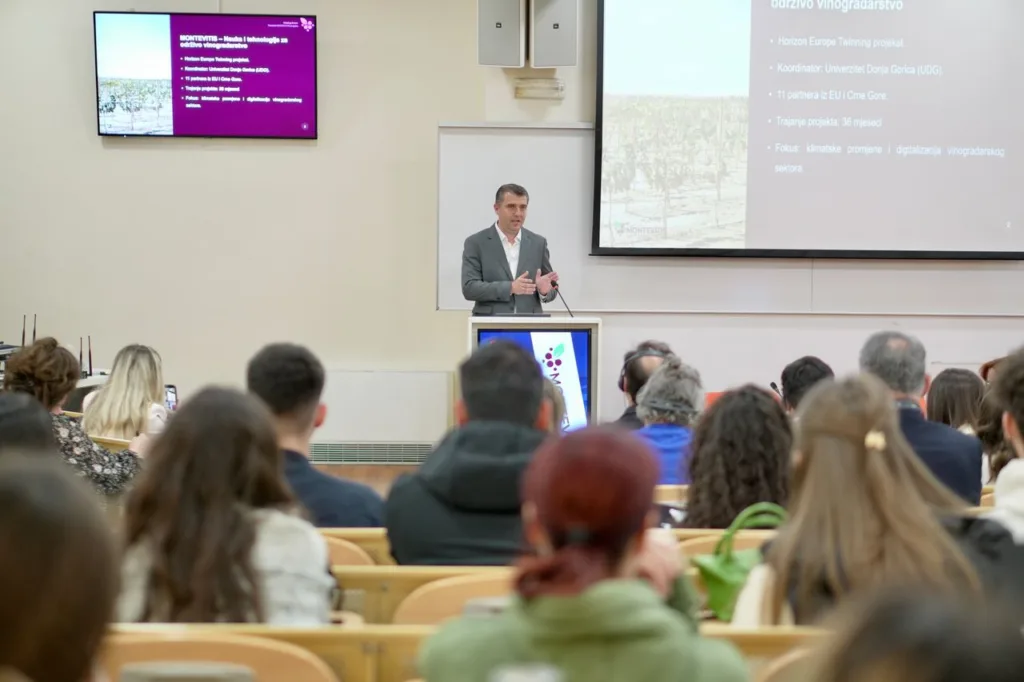
The event marks the culmination of a project implemented with the financial support of the European Union under the Horizon Europe program and aims to improve research capacities and international cooperation in the field of studying the impact of climate change on viticulture in Montenegro.
The MONTEVITIS project aims to develop an integrated European approach to understanding and mitigating the effects of climate change on the grapevine, as well as to define adaptation strategies that can contribute to the long-term sustainability of the viticulture and winemaking sector. The project has developed advanced analytical models that enable the assessment of the impact of climate change on the yield, ripening process and quality of grapes and wine, using modern information and communication technologies. A particularly significant result of the project is the development of the DSP – Decision Support Platform, a digital decision-making support platform intended for winegrowers and other stakeholders in the sector, in order to improve production planning and adaptation to climate challenges.
The event brought together representatives of the academic community, institutions, industry and the viticulture sector, as well as international project partners, and served as a platform for knowledge exchange, presentation of research results and strengthening cooperation between scientific institutions, decision-makers and business entities.
In the introductory part of the event, Prof. Dr. Maja Drakić Grgur welcomed the attendees on behalf of the University of Donja Gorica, emphasizing that the MONTEVITIS project is a product of curiosity and cooperation, and that science and innovation can help preserve natural resources and adapt the sector to climate change. The representative of the Ministry of Agriculture, Forestry and Water Management, Marija Krstić, thanked the University of Donja Gorica as the project coordinator for its commitment and effort to make Montenegro part of this research project, and emphasized the importance of Montenegro's participation in international research, given the importance of wine as one of the key export agricultural products.
During the first part of the program, Prof. Dr. Marko Simeunović, project manager, presented the key results. After the introductory presentations, lectures were held on the impact of climate change on European viticulture, as well as possible ways to adapt and mitigate its consequences. The lectures were given by EU partner institutions from Portugal and Germany.
The central part of the event included a thematic session in which researchers presented modern approaches to climate data analysis, climate change projection models, as well as research results related to the development of more resistant grape varieties and the influence of climate factors on the development and quality of grapes. The thematic sessions were held by partner institutions: the Institute of Hydrometeorology and Seismology of Montenegro (ZHMS), the Potsdam-Institut für Klimafolgenforschung from Germany, the Università degli Studi di Firenze (UNIFI) from Italy, as well as researchers from the University of Donja Gorica.
After the thematic sessions, a panel discussion was held, in which representatives of institutions (Ministry of Agriculture, Forestry and Water Management), the academic community (EU partners from countries with a long wine-growing tradition and highly developed research and innovation capacities in the field of viticulture and climate change) and the wine-growing sector (Rajković Winery, Plantaže and Vučinić Winery) participated, with a focus on the application of project results in practice and their harmonization with national strategies for agricultural development and sustainable resource management.
As part of the final session, a demonstration of the MONTEVITIS Decision Support Platform was held, during which participants had the opportunity to learn about the functionalities of this digital platform and its potential for supporting decision-making in the viticulture sector.
The project program also included field visits to partner wineries in Montenegro, where participants had the opportunity to learn about practical examples of the application of project results, analysis of viticultural practices and challenges facing the sector in the context of climate change. These activities included presentations of wineries, vineyard tours and discussions on lessons learned and opportunities for further development of the sector.
The final event of the MONTEVITIS project represents an important step in strengthening cooperation between science, industry and institutions, as well as in promoting innovative solutions for the sustainable development of viticulture in Montenegro and the region.






Comments