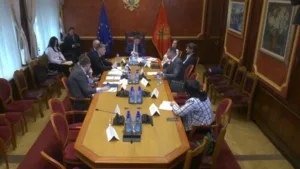

Paunović stressed that he fully supports the proposal that MPs and ministers should not be protected by immunity from criminal prosecution.

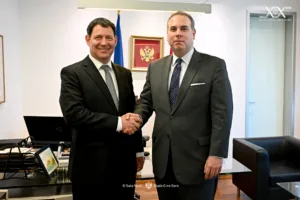
Mitar Paunović, photo: RTV PG
Paunović: It is important that everyone is held accountable for their crimes in real time

„Prvo smo imali najavu 44. Vlade Crna Gora, da ministar pravde više neće biti član sudskog savjeta. To su ustavne promjene koje Vlade Crna Gora i predlaže Skupštini Crne Gore.
"So it is a very important issue that the Minister of Justice, a member of the Government of Montenegro, will no longer be a member of the Judicial Council. And in this way, the main policies of the judicial system will be influenced to some extent, because its main role should be to reform the legal legislation, on the one hand, and on the other hand, to provide better working conditions for all judges and prosecutors in Montenegro," said Paunović.
When it comes to this second proposal, which is also related to organized crime and high-level corruption, as well as the lifting of immunity for current members of the Government, the proposal for members of parliament, or deputies in the Parliament of Montenegro, Paunović adds that he also supports it.
He referred to cases in the previous 3, 4 years, when changes occurred within the prosecutorial organization.
"We now have cases where some people from the highest executive branches are only now being held accountable, after they have left their positions. We have the time of the Democratic Party of Socialists' rule, when immunities in the Parliamentary Committees and in the Parliament of Montenegro were lifted only for opposition MPs. We also had the issue of the current Minister of Defense, Dragan Krapović, whose immunity was lifted," adds Paunović.
Paunović emphasizes that these are times that none of us want.
"And that is why this proposal is that all current government officials, including the highest officials, that is, members of the Government, ministers and the Prime Minister, if, of course, they commit criminal acts, we will not wait for their mandate to end, nor will their prosecution depend on the political will of the MPs, but these people will finally be left without immunity in the context of these acts," said Paunović.
However, he believes that someone cannot and should not be left without immunity if they commit an offense due to their statement or political work.
"But when it comes to organized crime and high-level corruption, of course, he should not be protected by immunity and that would put off criminal prosecution. It is important that everyone is held accountable for their crimes in real time, which is why I fully support this proposal."
Citing the example of the former President of the Supreme Court, Vesna Medenica, he emphasizes that this is the third time a first-instance verdict has occurred, and that such verdicts are very significant.
"Here, in the case of the "Mother of Justice of the Montenegrin judiciary", Vesna Medenica, the unconstitutional president of the Supreme Court, for the third time there has been a first-instance verdict, which even amounts to 10 plus two years, or 12 years for the former president of the Supreme Court, for a woman who was at the head of the Montenegrin judiciary. We will see what the epilogue will be and what the final court verdict will be, but certainly, these are all significant things," said Paunović.
Vukotić: Justice in Montenegro is slow, but it still exists
The President of the URA Youth Forum, Luka Vukotić, said that the law is not the same for everyone, and that for over 30 years we have not been able to reach certain verdicts, because some cases are becoming statute-barred.
"The immunity enjoyed by MPs and certain state officials, however, if we look at the practice of the previous 30 years, we see that it served the least purpose and that it somehow protected from criminal liability, which bypassed many high-ranking, actually the highest officials in this country for over 30 years, so even today we cannot reach certain verdicts, because simply, some cases become statute-barred and time completely loses them," Vukotić points out.
Immunity, as Vukotić says, should remain, but a boundary should be created between publicly spoken words and a criminal act.
"So, for the word spoken publicly, at public functions, a clear line should be drawn between that item of spoken word and criminal liability, because politics in Montenegro, especially politicians who have been there for the past 30 years, have been walking very thinly on that edge of the law, even crossing it very often, and perhaps it would be good to change the atmosphere in which today's generation of politicians, as well as this current government, will not dare to do something like that."
This, he says, will likely serve as a warning for their further actions.
Vukotić adds that 5 years ago, such issues were not mentioned in public, nor were they discussed.
"Only the opposition raised these issues. What happens later? Yes, processes have been initiated, they are very slow, but they are happening. That is again commendable in that regard. The former President of the Supreme Court was sentenced to 12 years. So, justice does exist in Montenegro. It is very slow, and it seems to me to be quite selective, but there is hope, when we see that such verdicts are happening, there is hope that the system may work someday," said Vukotić.