
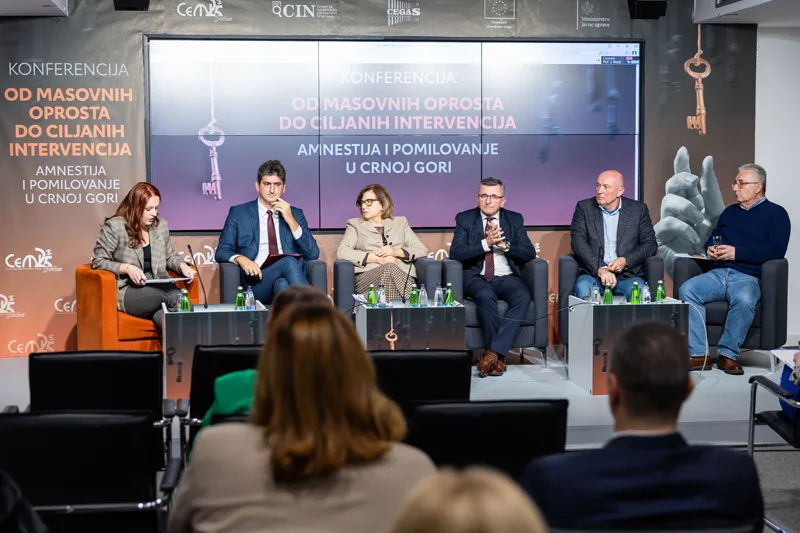
These are messages from the panel that was organized as part of the conferencee Center for Monitoring and Research (CeMI) "From mass pardons to targeted interventions - amnesty and pardon in Montenegro".
Professor of criminal law prof. Dr. Vesna Ratković, indicated that information systems in the field of justice have a serious problem when it comes to the extraction and availability of data.
"Which is not only a methodological difficulty, but an established practice in which statistical data and their availability actually do not exist, despite the digitization process," said Ratković.
Speaking about the amnesty, Ratković pointed out that it is a collective measure with an extensive effect, which as a rule includes a large number of persons.
"On the contrary, the act of pardon is an individual, reconstructive administrative act, which does not only affect the person who was pardoned, but has wider social implications," Ratković explained.
She emphasized that the pardon procedure is not a judicial one, but an administrative one, and that the Ministry of Justice does not participate in that process, but rather the courts.
According to her opinion, "the courts completed their role by passing a final verdict, and their additional involvement in the pardon procedure would represent an unnecessary administrative burden."
"In my opinion, this is a job for the Ministry of Justice," she is clear.
Ratković reminded that the pardon is a discretionary right of the president of the state, based on the principle of opportunity, that is, on the assessment of expediency and the existence of conditions for a pardon, and that the legal and political aspects of that institute cannot be viewed separately.
"Both amnesty and pardon have a strong political connotation, where the "winners" are not only those who receive amnesty or pardon, but also those who make those decisions," Ratković is clear.
She assessed that both institutes should be applied very restrictively.
She pointed out that the public already has expectations and reminders of convicted persons about earlier promises, and that, although the current amnesty proposal has not been adopted, it is not excluded that the preparation of a new one will soon follow.
Advisor for legal issues to the President of Montenegro, Ivan Šikmanović he said that the President of Montenegro, in accordance with the Constitution, is competent to grant pardons
"In the reporting period, what is noticeable is that there is an increase in the number of requests for pardons," said Šikmanović and reminded that President Milatović took office on May 21, 2023.
He indicated that in the past two and a half years, a total of 134 petitions for pardons were submitted, of which 124 were not accepted, while ten petitions were approved, and six more petitions for pardons are currently being processed.
"In the first phase, the Ministry of Justice receives and processes applications, in accordance with Article 11 of the Law on Pardons, and is obliged to obtain all relevant information that may be of importance for making a decision", reminded Šikmanović
This, as he explained, includes data on committed criminal acts, imposed sentences, final judgments, as well as social and other circumstances related to the applicants.
"After the analysis and evaluation of all collected information, the Minister of Justice submits a proposed decision to the President of Montenegro, together with complete documentation, which then comes to the President's cabinet for consideration," Šikmanović said.
As he explained, upon receipt of the application in the office of the President of Montenegro, the authorized officer checks its completeness and orderliness, and if necessary, through official communication with the Ministry of Justice, additional clarifications or additions to the documentation are requested.
Šikmanović pointed out that the next step is to consider the petition before the commission that was recently formally formed within the president's cabinet.
"The commission consists of the head of the office of the President of Montenegro and several advisers from areas that may be relevant for decision-making in specific cases. The commission considers all aspects of the application based on the information provided by the Ministry of Justice and gives its opinion to the president, who in the final stage makes the final decision," Šikmanović explained.
CEGAS representative Boris Marić said that he has the impression that "we have not dealt with the amnesty and pardon systems seriously and systematically enough and that he does not see a clear political will to enter into the reform of that process".
Marić assesses that in practice, amnesty laws are passed too often and without a strategic approach, while the pardon procedure is weakened by the omission of the role of the courts, which undermines the constitutional balance and additionally burdens the perception of the independence of the judiciary.
"When the amnesty or pardon procedure is entered, there are almost no adequate explanations as to why the process is initiated, either systemically or in individual cases, which seriously threatens public trust," said Marić.
According to him, greater transparency of procedures, especially through clear and accessible explanations of decisions, could significantly contribute to strengthening citizens' trust in institutions.
"One of the first measures that could be introduced, although it is not currently provided for by law, is to make pardon requests available to the public. This would significantly contribute to the transparency of the procedure," said Marić.
He warns that on the eve of election cycles there is an increase in requests for pardons, which indicates the belief that the political context can influence the outcome of such procedures and that it is necessary to react preventively.
"The binding of legal institutes must be clear and consistent. Changing a short prison sentence to probation can be an acceptable solution, but only with a complete, precise and publicly available explanation," concluded Marić.
Lawyer Veselin Radulović reminded that amnesty and pardon institutions are most often seen as an expression of the state's mercy towards convicted or accused persons, but he warned that such "correction of law", which comes from other branches of government, inevitably leaves consequences for the work of those who passed judgments in those cases, both judges and prosecutors.
"In a situation where there is an extremely mild criminal policy, with frequent passing of amnesty laws and a significant number of decisions on pardons, the impression is created that the state's reaction to crime is not what it should be," said Radulović.
He assessed that such an environment is the result of political decisions, and that the responsibility lies primarily with the decision-makers, because "convicted persons already at the moment of the sentencing count that the sentence will not be final and that they will not fully endure it".
As he stated, it is based on the assumption that the sentence will be changed to parole, that it will be shortened by one third due to correct governance in the prison, which, according to him, happens almost regularly in practice, and then from the expectation that the Parliament will pass a new law on amnesty, which would further reduce the sentence by 20 to 25 percent.
"When all these factors are added up, especially in cases of organized crime and corruption, we come to the conclusion that even the formally lenient penal policy was not actually carried out in full, but that the punishments were significantly reduced and mitigated, which, as he assessed, never gives a good effect," Radulović explained.
Such a practice, he concluded, leaves a strong impression on the public that the efforts of the judiciary are meaningless and that the message of the fight against crime is relativized.
Journalist Zoran Radulović he pointed out that the issue of amnesty is dealt with less today than before, and that the statistics themselves show a certain stagnation, but without clear explanations.
"Whether it is due to the lack of candidates or the lack of complete records. This is precisely why it is not possible to compare who was pardoned and who was not, how many returnees are among the amnesties, nor to see the real effects of such decisions," said Radulović.
"It is particularly problematic that in Montenegro individuals have been pardoned and convicted of serious crimes, from accepting bribes and police violence, through organizing cigarette smuggling, to violence against women, and this in periods when institutions publicly declared the fight against organized crime, corruption and gender-based violence," he said.
"When individual cases are looked at, it becomes clear that the subject of amnesty is much more complex and meaningful than mere statistics show," stressed Radulović, adding that these cases opened up space for serious journalistic stories, but without a visible social effect.
Speaking about the role of the media, Radulović concluded that they can have a significant role, but also a negative effect if these topics are misused, reducing them to daily-political, instead of public interest, which, as he assessed, is a frequent practice.
The conference is part of the project "Support for the EU integration of Montenegro - for an independent and professional judiciary as a key prerequisite!" which is carried out by the Center for Monitoring and Research (CeMI), in cooperation with the Center for Investigative Journalism of Montenegro (CIN-CG) and the Center for Civil Liberties (CEGAS), and is financed by the European Union and co-financed by the Ministry of Public Administration of Montenegro.
Comments