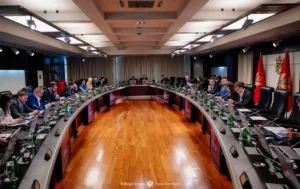

The conference also stated that consideration should be given to professionalizing the Prosecutorial and Judicial Councils in the future, following the example of the Central Election Commission (CEC).
CDT Program Director, Milica Kovačević, said in her introduction that without justice there is no progress or development in any area.

"It is not enough to talk about harmonization and normative improvements that attract praise from various sources, but are unsustainable in practice and do not lead to appropriate changes. We talk about the same problems in the judiciary year after year," she said.
Minister of Justice, Bojan Božović, announced that the Government, in communication with the European Commission and international partners, received a recommendation that the Constitution should be amended in such a way that the Prosecutorial Council becomes a constitutional category, and that this should certainly not be controversial for the Judicial Council.
"One of the obligations for closing the chapter is to accept these EC recommendations, most of which are more than 7-8 years old. We adhered to the principle and proposed that this be transposed into the Constitution, without the Minister being part of the Judicial Council. We have committed ourselves, as the Government, not to participate in the work of the Judicial Council," the minister announced, assessing that it is good that both the Judicial and Prosecutorial Councils be part of the Constitution.
"And that the formal and legal influence of the executive branch on the prosecutorial and judicial branches is further reduced and formally abolished, with the proviso that the representative of the Ministry of Justice will of course have a role in the judicial world," said Božović.
Member of the Judicial Council, Miodrag Iličković, recalled that we made an attempt to free both councils and the prosecutor's office from political influence in 2013.
"I was delighted. The opposite happened. It was all packaged up, the government realized that they would transfer enormous power to the judiciary and the Constitutional Court, that ultimately the judiciary would become a very powerful branch of government, and then they made a convulsion, they elected obedient people at the expense of quality," said Iličković.
The government at the time, he added, brought in people who had never entered a courtroom, who did not have a bar exam... "But they were a sure vote. The manner was, let's choose five sure votes, they will write separate opinions, a mimicry of all that is created. It was similar in the prosecution, safe guys were brought in, the matter was concluded formally as Europe requires, and we finished the job for ourselves," Iličković said.
Speaking about the current proposals for changes to the Constitution, Iličković said that "it's a shame to slaughter an ox for a kilo of meat."
"If we were to change the Constitution for these things, I think we have a perfectly good normative framework. I am against the minister not participating in the Judicial Council, he does not have to influence the careers of judges, but the minister is needed, he has responsibilities for finances, the budget... The government has decided that the minister will not participate in the work of the Judicial Council, where does the minister have the authority to behave unconstitutionally?", he said, adding that the proposed changes to include more judges and fewer reputable lawyers in the council do not bring anything special.
"The balance of having more judges and fewer reputable lawyers doesn't bring anything special either. Judges are responsible to their colleagues who elected them, to protect the profession, reputable lawyers to the parliament that elected them, that's a great balance. The President of the Judicial Council is elected by a two-thirds majority, and then again by the Judicial Council, he has a double capacity, he has the legitimacy to draw on that "golden vote", said Iličković.
Lawyer Siniša Gazivoda recalled that the Venice Commission said that two things should be taken into account – that corporatism, or complete closure, does not occur. "That all power must come from the will of the people, so that the influence of parliament is not lost," he said. The second thing the VK pointed out, he says, is politicization, or excessive political influence.
"In my opinion, it would be very bad if, because of the European agenda, we skipped something and wrote into the Constitution some things that will remain there for more than a decade. Our Constitution is rigid and it is not easy to change it," said Gazivoda.
He said that it would be good to consider professionalizing both the Judicial and Prosecutorial Councils. "Not to terminate the mandate of the current ones, but for the future, like what is being done with the CEC. The jurisdiction of the Judicial and Prosecutorial Councils has so much work that they would have something to do every day, all day long," said Gazivoda.
The Minister of Justice also agrees that we should consider professionalizing the councils.
Božović also stated that Montenegro would not have received a positive IBAR if the Government had not made the decision it did, and if the Minister of Justice had not participated in the work of the Judicial Council.
"That was imperative. I thought there were good reasons why the Minister of Justice should be on the Judicial Council, but there were also counterarguments, the EU had a tougher stance on that issue," the minister said.
The interlocutors agree that it will be very difficult, if not impossible, to completely free the judiciary from political influence.
"The only way for the judiciary to be cleansed of political influence is to strengthen that same judiciary. We as a society must create better conditions for that. If someone wants to abuse a norm, they will abuse it regardless of how it is written. Will this absolutely get rid of all political influence, I don't think so, I don't look at things through rose-colored glasses. If someone is going to be immune to political influence, it will be, even if there are three more of us there," said Minister Božović.
Gazivoda pointed out that he has been in the courtroom for 15 years and has never suspected that anyone took the money, even though citizens think otherwise.
"And the perception of citizens is often such, at least from what I hear, that this is the case. I also think that at least recently, it has not happened that someone orders a verdict by phone, and I don't believe it has happened before, and that is also the perception of citizens that this is how it works," he said.
"What I think is happening as a negative impact, in a certain number of cases, is self-censorship, from the great pressure exerted by politics, which creates a general expectation among the public and that these are not circumstances in which it is easy to judge and work," Gazivoda concluded.