
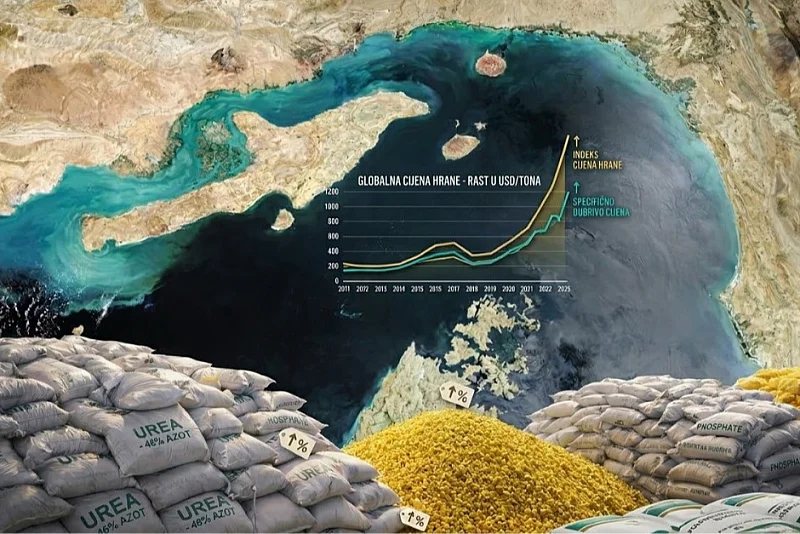
This narrow passage between the Persian Gulf and the Gulf of Oman is a key point for the world's trade in mineral fertilizers.
Any serious disruption to shipping traffic through this strait is already starting to raise fertilizer prices and raise concerns about the possible consequences for global agricultural production, reports Klix.
According to commodity market analysts, about a third of the world's total maritime trade in fertilizers passes through the Strait of Hormuz. The Persian Gulf countries are also among the largest exporters of key ingredients for food production.
It is estimated that producers in the region account for about 43 to 49 percent of global urea exports, while they account for approximately 30 percent of global ammonia exports. In addition, Gulf ports also handle about 44 percent of the world's seaborne trade in sulfur, a key input for the production of mineral fertilizers.
Nitrogen fertilizers, such as urea and ammonia, are crucial for high agricultural yields. Their production is heavily dependent on cheap natural gas, which the Gulf states have in large quantities. Almost all exports of these products from Qatar, Saudi Arabia, the United Arab Emirates and Iran must pass through the Strait of Hormuz.
Tensions in the region have already begun to have a tangible impact on the market. Fertilizer prices have risen by about 30 percent since late February, while some ships carrying the fertilizer remain stranded in Persian Gulf ports. This is further slowing shipments as many countries enter the crucial spring planting period.
The biggest blow is already being felt in some countries in Asia and Latin America. In India, Pakistan and Bangladesh, fertilizer prices are rising, while gas shortages are further affecting domestic factories. Brazil, one of the world's largest soybean producers, is facing rising fertilizer costs that are threatening production profitability.
A similar trend is being seen in China and Southeast Asian countries, where fertilizer prices are soaring. In parts of Africa, experts warn that potential shortages could further worsen already fragile food security.
Analysts warn that any serious closure or long-term disruption to navigation through the Strait of Hormuz could cause a chain reaction - from rising fertilizer prices, to falling agricultural production, to rising food prices around the world.








Comments