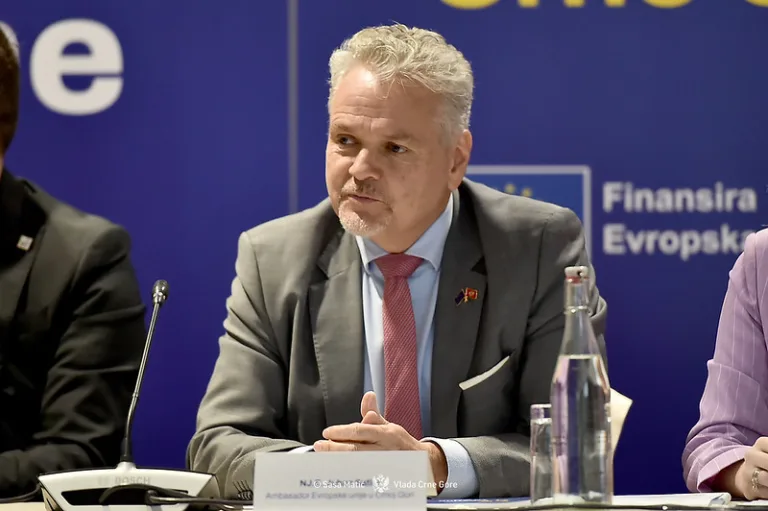
"The most challenging chapters come at the end - Chapters 23 and 24, which deal with the rule of law, the fight against organised crime and corruption, as well as the chapter on environmental protection, which is extremely important but also very complex. In October and November, we will have a clearer picture of how realistic it is to close all the chapters," Sattler told Euronews.
When asked what concrete progress has been made in chapters 23 and 24, especially in the areas of rule of law and fundamental rights, and whether these chapters remain the most challenging, Sattler said that according to "our methodology, in order to close any chapter, you must have a certain level in the area of rule of law and justice - the so-called IBAR".

"Montenegro crossed that threshold two years ago. It is a condition that every country must meet in order to progress in other chapters. If you are not sufficiently prepared in the area of the rule of law, you cannot progress further. Chapters 23 and 24 are extremely important, but there is also the chapter on the environment, which represents a major challenge. It is one of the largest and most expensive chapters, as it involves the construction of wastewater treatment plants, improving air and water quality, as well as harmonizing a large number of regulations. There are also other demanding chapters, such as the free movement of goods, which require a lot of technical work. Administrative capacity is also an important aspect - strengthening the institutions that will implement the adopted laws. For example, in the area of agriculture, it is necessary to form agencies that will manage EU funds intended for farmers. This is a key part of the work ahead," said Satler.
Regarding electoral reform, he emphasized, the first part was successfully completed last year and that is no small achievement.
"For the first time, a single date for local elections every four years has been agreed, which was not easy to achieve. The professionalization of electoral bodies has been agreed, as well as a 40% quota for women in parliament. These are important steps, but the work is not done. We are in communication with parliament, both with the majority and the opposition, regarding the second part of the reform. It is important to improve the rules on financing political parties, as well as clarify certain technical aspects, such as the second round of presidential elections. I call on parliament to complete this work in order to fully complete the reform," said the ambassador.
Speaking about the opposition and the recent withdrawal of opposition representatives from parliamentary committees due to the security law, Sattler emphasized that the European Union, but also he personally, attaches great importance to national cohesion when it comes to such a strategic issue as EU membership.
"Part of the good results from the past two years are precisely the result of this unity - cooperation between the government and the opposition. Many laws were adopted with broad support in parliament. That is why it is crucial to return to this approach. I call on both the government and the opposition, and especially the majority, to work on restoring this unity, because it is a prerequisite for completing the demanding work ahead," said Satler.
Commenting on the formation of a commission to draft a new agreement regarding the process of Montenegro's accession to the European Union, he said that yesterday we really saw good news from Brussels.
"That is, the formation of a working group that will start working on the accession treaty. This is a really big step. Congratulations to all the citizens of this country, as well as to all the actors – whether they are in the government, the majority or the opposition, because there are many of them. This is a big step. As has been said, this restarts the clock for the next enlargement, after 13 years, after Croatia, which was the last to join in 2013. This means that now, in parallel with the technical work on the chapters – and we still have a lot of work to do on this issue – we are also starting this process. We hope that we will manage to close four more chapters before the summer break, and then the rest in the second half of the year. The accession treaty itself is now being prepared. The last one was with Croatia 12 years ago. In the meantime, certain changes have occurred, so this accession treaty will be somewhat different. We still do not know exactly what it will contain, but it will, of course, include the rights and obligations of Montenegro, as well as the exceptions, transitional clauses and safeguard mechanisms, as Commissioner Kos mentioned. About everything "This will be discussed very intensively in the next six to eight months in Brussels," Sattler said.