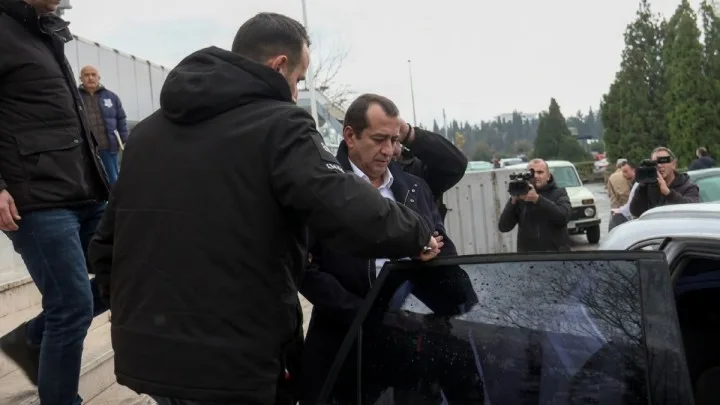
He was arrested in the Podgorica neighborhood of Siti Kvart in an operation by the Special Police Department (SPO).
Although there is no information about the reasons for the arrest, speculation emerged yesterday that it could be related to Čađenović's actions in the "Telekom" case.
The suspended prosecutor's lawyers, Vaso Bečanović and Lazar Aković, did not have any specific information about what was going on. The SDT did not respond.

The Higher Court in Podgorica lifted Čađenović's house arrest at the end of October last year.
The Special Prosecutor's Office charges Čađenović with being a member of a criminal organization that, according to the indictment, was formed by former police official Zoran Lazović. In addition to them, former Chief Special Prosecutor Milivoje Katnić, who is in the UIKS, as well as Lazović, are also accused.
However, for keeping two cases, including the "Telekom" affair, in a drawer for years until they were time-barred, Saša Čađenović was recently punished with a 40 percent salary reduction for a period of six months and a two-year ban on promotion. This was decided by the Disciplinary Council of the Prosecutorial Council.
The NGO MANS previously stated in a statement that although the organization filed a criminal complaint in March 2019, the case known as the "Telekom" affair was opened years earlier.
"Following information published in the media, MANS has information that State Prosecutor Dražen Burić was the person handling this case, even before the establishment of the Special State Prosecutor's Office in 2015. After the establishment of the SDT, the case was taken over by Special Prosecutor Saša Čađenović, and after his arrest by Special Prosecutor Ana Perović Vojinović. It was Perović Vojinović, as the applicant, who informed the NGO MANS in a letter dated July 31, 2025, that the criminal report had been dismissed because the statute of limitations had expired. While Saša Čađenović was the person handling the case, the Special State Prosecutor's Office was headed by Milivoje Katnić, the former chief special prosecutor," MANS specifies.
They also remind that this NGO filed a complaint against the work of Perović Vojinović, but that the State Prosecutor at the Supreme State Prosecutor's Office, Veljko Rutović, assessed that "a correct and lawful decision was made in the form of a reasoned decision with sufficiently clear reasons."
In this way, MANS says, the prosecution is discreetly trying to close the affair that has burdened the Montenegrin public for years.
The "Telekom" scandal was opened at the end of December 2011, but to date no one has been convicted. The US Securities and Exchange Commission (SEC) announced at the end of 2011 that has evidence that there was bribery in Montenegro during the privatization of a telecommunications company, and that the then officials were involved in everything, but the Montenegrin prosecutor's office has not yet revealed those responsible.
Urošević: "Telekom" must not be a forgotten affair
The President of the Parliamentary Commission for the Control of Privatization, Uglješa Urošević (PES), told the RTCG Portal that the arrest of the suspended special prosecutor Saša Čađenović reopens a question that the public must not forget: whether, apart from the previous disciplinary punishment, he will ever bear real responsibility for his actions in the "Telekom" case, one of the most important cases of high-level corruption and privatization in Montenegro.
"However, regardless of what happens in the proceedings against Katnić, Čađenović or any third parties, one question must not be swept under the rug: is it normal for the "Telekom" case, one of the largest privatization and corruption scandals in Montenegro, to become statute-barred, without anyone being held accountable for it? It is particularly important that the Supreme State Prosecutor's Office, regarding the "Telekom" case, announced that the decisions were made in accordance with the law. The Supreme State Prosecutor's Office stated that the statute of limitations for certain criminal offenses occurred well before the filing of the criminal complaint by MANS in 2019: for abuse of office on March 31, 2015, for bribery on May 15, 2011, for money laundering on May 15, 2016, and for accepting a bribe on May 15, 2021," explained Urošević.

In other words, he adds, the prosecution is now saying - when the statute of limitations has already expired, the current prosecutor cannot take procedural actions by law.
"That may be a legal explanation for the current decision, but it is not the answer to the public's essential question: who allowed the statute of limitations to occur? It was the Supreme State Prosecutor's Office that stated that the responsibility for the omission lies with the previous case handler and the previous head of the Special State Prosecutor's Office, and that the current Chief Special Prosecutor submitted a proposal to the Prosecutorial Council to determine the disciplinary liability of the previous handler. That is the key to the whole story. If the current decision is formally legal because the statute of limitations has already expired, then the political and institutional issue does not end with that decision. On the contrary — that is where the real question begins: how is it possible that state authorities have not ensured timely action for years in a case that had an international dimension, serious corruption suspicions, and a direct connection to the privatization of state property," said Urošević.
As he states, according to previous information, Čađenović was disciplined by the Prosecutorial Council for his actions in the "Telekom" case.
"However, if the ultimate outcome of one of the biggest scandals is that the case becomes statute-barred, and the responsibility is reduced to a disciplinary measure and a salary reduction, then an extremely dangerous message is sent to other prosecutors: that high-level corruption cases can be held for years, that they can become statute-barred, and that the consequences are minimal in relation to the damage caused to the public interest. Therefore, the "Telekom" case must not be viewed only through the prism of one prosecutor or one disciplinary proceeding. Here, the question of the entire chain of responsibility must be raised: who was processing the case, who was the manager, who was supervising, who knew that the deadlines were running, why there was no response on time and whether there were omissions, obstructions or institutional protection of non-action," said Urošević.
"The Assembly must not remain silent"
He explains that as a member of the Parliament of Montenegro and President of the Commission for Monitoring and Control of Privatization Procedures, he believes that the Parliament must not remain silent.
"The Assembly should not take over the work of the prosecution and courts, nor should it pass judgment on anyone. But the Assembly has the right and obligation to raise the issue of political and institutional responsibility for the way in which state authorities acted in the "Telekom" case. Especially considering that this case is related to the privatization of a former state-owned enterprise, that it has been mentioned in public for years as an example of high corruption, and that it had an international dimension, the Parliament must consider all available mechanisms: control hearings, a thematic session of the competent committees, but also the possibility of forming a committee of inquiry. It is not the task of the committee of inquiry to determine criminal responsibility. That is the job of the prosecution and the court. But it is the task of the Assembly to determine how the institutions worked, why deadlines were missed, whether there were systemic failures, and why it is only after the statute of limitations has expired that the public is informed that there is no longer any possibility of taking legal action." "That's why the question for this year remains very specific: will we allow the "Telekom" case to be archived as another affair without an epilogue, or will we open a parliamentary investigation in the Parliament into the institutional handling of this case," said Urošević.
He stated that if the prosecutor's decision today is formally correct because the statute of limitations has already expired, then someone must answer why justice was delayed.
"Because the statute of limitations is not justice. The statute of limitations is a defeat for the state. And in the case of "Telekom", it is a defeat that must not be forgotten," concluded Urošević.