
Of that amount, 12.6 million euros were provided from donations, primarily from the European Union, while 82 million euros were financed by the German Development Bank (KfW) and the European Bank for Reconstruction and Development (EBRD), with a contribution from the state.
– With 104 million euros provided for energy efficiency improvement projects, REEP is impacting tangible improvements in the education, health and housing sectors in Montenegro. The energy-efficient reconstruction of the Clinical Center in Podgorica and 46 schools is underway, while 180 households have already been given the opportunity to introduce innovations with long-term positive effects on health and living comfort. These efforts are expected to save 48,722 MWh of energy annually and reduce CO₂ emissions by 13,429 tons – KfW and EBRD said earlier.

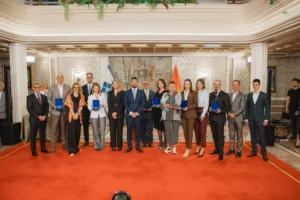
It is a program that helps Western Balkan countries improve the energy efficiency of buildings and align their legislation with the EU acquis. The European Commission's program manager Ekatarina Bakalova previously pointed out that REEP is an example of how the EU, together with KfW, EBRD and the Government of Montenegro, is encouraging large-scale sustainable investments.
Minister of Energy and Mining Admir Šahmanović said that this program was helpful in harmonizing the legislation on energy efficiency with European directives.
By replacing roofs, installing LED lighting, installing thermal insulation, reconstructing bathrooms and other activities to increase energy efficiency, numerous Montenegrin schools will achieve annual energy savings and a reduction in CO2 emissions of 50 percent, and some up to 90 percent. Through this project, the Secondary School of Economics and Catering and DIF in Nikšić, the "Njegoš" primary school in Kotor, the "Srbija" and "Jugoslavija" primary schools in Bar, "25. maj" in Tuzi and the Cetinje Gymnasium and Secondary Art School "Petar Lubarda" have so far been reconstructed.
The reconstruction of two primary schools in Bijelo Polje, "Vladislav Ribnikar" and "Risto Ratković", and the primary school "Vuk Karadžić" in Berane, is expected to be completed this year.
The construction of a new facility with 46 rooms on 3,500 square meters of the Grabovac Nursing Home in Risan is expected to be completed by the end of the year, and according to estimates, energy consumption should be halved and CO2 emissions should be reduced by as much as 80 percent. Risan's "Veljko Drobnjaković" elementary school is also awaiting works that should increase the level of energy efficiency from April. The plan is for this project to begin in April at the "Ilija Kišić" elementary school in Zelenica, and during this year at the "Radojica Perović" elementary school in Podgorica, and at the Nikšić Gymnasium and Secondary Vocational School. This project started in 2019 with the signing of the contract, and is expected to last until the end of next year.
REEP was launched in 2012 under the Western Balkans Investment Framework, combining EBRD and KfW financing with EU and other donor grants for investments, technical support and reforms. So far, the programme has mobilised over €1.1 billion at regional level. The total EU contribution to the WBIF REEP is €276.5 million, including a top-up of €90 million in 2025, to maintain and further accelerate the green transition momentum of the Western Balkans.