
The Head of Unit for Montenegro in the EU Enlargement Directorate, Barbara Jesus Žimeno, said during the meeting that the Commission welcomes the Montenegrin government's continued commitment to EU-related reforms, which has resulted in significant progress, as well as the closure of six negotiation chapters last year and one at the beginning of this year.
"Another one is expected in the coming weeks, bringing the total number of provisionally closed chapters to 14 soon. This makes Montenegro the most advanced country in accession negotiations, a leader among leaders. This current dynamic in accession negotiations has not been seen since Croatia's accession," Jesus-Žimeno pointed out.
She also noted that Montenegro is also the best among candidate countries in implementing the reform agenda within the Western Balkans Reform and Growth Instrument.
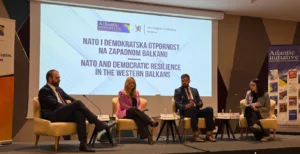
Clive Rumbold, Western Balkans expert at the European External Action Service, said that 2026 is a key year, in which Montenegro celebrates 20 years of independence, and also hosts the EU-Western Balkans Summit in June and the Berlin Process Summit in the fall.
He emphasizes that the ambition to join the EU in 2028 is achievable if Montenegro maintains the pace of accession work.
"To start drafting the accession treaty, Montenegro needs to close as many chapters as possible before the EU-Western Balkans Summit in June, prioritizing concrete progress in chapters 23 and 24 on the rule of law, which remain key reference points for progress and demonstrate a clear track record in the fight against organised crime and high-level corruption, as well as full alignment with EU visa policy," Rumbold added.
He emphasizes that advancing reforms requires continued political focus, cross-party consensus, and dialogue between institutions and with civil society.
"Montenegro's Constitutional Court remains incomplete, so Montenegro needs to further strengthen the independence of the judiciary, including securing key appointments of judges and prosecutors. Resolving bilateral issues with Croatia would help Montenegro move forward, including closing Chapter 31," Rumbold added.
The Head of the Mission of Montenegro to the EU, Ambassador Petar Marković, recalled the results that Montenegro achieved in the previous period and said that the country is in full swing in implementing reforms.
"Both the ruling majority and the opposition explicitly support our accession. Legislation aimed at harmonizing with the EU acquis is regularly adopted, with support across the political spectrum, often unanimously," Marković assessed.
He adds that political competition is "very lively" in Montenegro.
"This is part of our political culture and a normal development in any democratic system, but on fundamental issues of European integration and the basics, the consensus is stable and broad. Political differences on the domestic scene and dynamic regional events exist, but these are internal political choices, not whether we belong to the European Union. I think this is a fairly recognizable characteristic of Montenegro," said the ambassador.
Marković also pointed out that this year we aim to meet all the criteria for closure.
"We cannot dictate the dynamics in the Council, but it is also the year in which, if we continue good coordination and achieving results, we aim to close accession negotiations in 33 chapters. Whether that will spill over into a month or two in 2027 is a secondary issue for me because meeting the criteria for closure is the key," Marković assessed.
He reiterated Montenegro's strong support for the merit-based approach to enlargement as superior to any other alternative.
Marković: There is no talk of amending the citizenship law
When asked by Chairman Thomas Weiss whether Montenegro was preparing legislation related to the possibility of dual citizenship, Marković responded that the issue was not being considered.
"There are no concrete or abstract plans to do this, just as there were none in the past. Montenegro has a citizenship law that, given its size, has a typically restrictive concept of citizenship, and there are absolutely no plans to change that in the future," Marković says.
Sokol: Certain actors threaten Montenegro's EU path
European Parliament member Tomislav Sokol assessed that Montenegro has done a lot on its EU path, but that Serbia's malignant influence is still present. He said that Serbian President Aleksandar Vučić is using parts of the ruling majority for destabilization.
"First we had the situation where DNP, Milan Knežević's party, left the government, which we all know is directly connected to Belgrade and is directly connected to Vučić. But we also see the Democrats, another party that is part of the ruling majority, abusing the security apparatus entrusted to them, because they control key ministries in the government in order to put pressure on the opposition, on opposition media, etc.," Sokol assessed and asked the commission what it would do regarding, as he put it, the issue of the Democrats' connection to Belgrade.
The Commission representative pointed out that there are certain political parties that do not support Montenegro's EU path and that are "under the external influence of certain forces that are not conducive to Montenegro's EU path."
"We are aware of this, but Ambassador Marković said that there is consensus across the party spectrum when it comes to Montenegro's European path, which is in line with the expectations of citizens," Jesus-Žimeno pointed out.
Ambassador Marković responded to Sokolov's political statement, saying that it was inappropriate for the ambassador to go into details about the defense or non-defense of certain parties.
"But I would say that, given the history of your positions on one of the parties that is no longer part of the majority, I would expect you to welcome a situation in which the majority is now even clearer about its European credentials and about allegations of ties to Belgrade and Moscow," Marković replied.
When asked about bilateral relations with Croatia, Marković emphasized that the issue of fair reparations for Croatian citizens imprisoned in the Morinj camp is "Montenegro's historical debt in dealing with the ugliest episode in its recent political history."
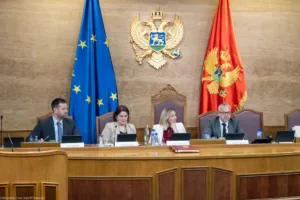
It was announced at the meeting that the next Stabilization and Association Parliamentary Committee will be held on April 29 and 30 in Strasbourg.