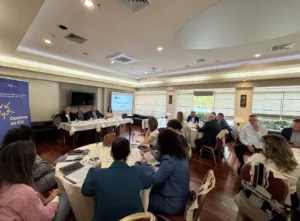

CEES announced that the modern financial environment, characterized by rapid technological changes and the spread of digital services, places great responsibility on individuals for managing their own finances.
"These issues are of particular importance when it comes to young people, since it is during this period of life that the first independent financial habits are adopted, money management patterns are developed, and attitudes towards savings, spending, borrowing, and digital security are shaped," the statement states.
Nina Vujošević from CEES, Petar Đukanović from the Center for Civic Education (CCE) and Vuk Čađenović from the DAMAR agency will discuss the key findings of the research, which provide in-depth insight into how young people aged 15 to 25 make financial decisions and how skilled they are in recognizing risks in the online space.


A special focus of the research is on comparing two key groups – high school students (15 to 18 years old) and young adults (18 to 25 years old), in order to enable comparison of different levels of financial independence, knowledge, experiences and needs.
In addition to describing the level of knowledge of basic economic concepts, the research results also reveal specific experiences and behaviors related to savings, consumption, and digital security, with an analysis of differences by gender and region.
"The aim of this event is to open a space for discussion on how educational institutions, decision-makers and the financial sector can contribute to better empowering young people, in order to reduce their exposure to financial fraud and improve their digital readiness for the future," the statement said.
The Digital Security for Greater Financial Inclusion of Youth project, implemented by CEES, is supported through the Protection of Rights and Promotion of Digital Citizenship: Montenegrin Digital Shield (MDS) program, implemented by CCE in partnership with the SHARE Foundation and in cooperation with the Agency for Audiovisual Media Services, with the financial support of the European Union and co-financing from the Ministry of Regional and Investment Development and Cooperation with NGOs.