
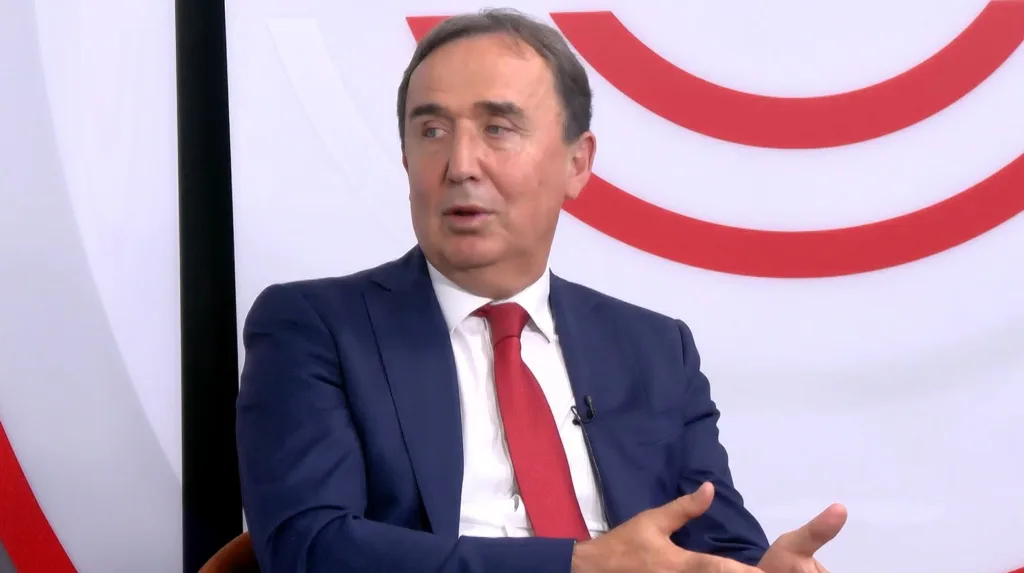
The President of the Board of Directors of the Regional Water Supply Company of the Montenegrin Coast, Zoran Lakušić, said that the essence of the problem lies in the calculation models that are based on the assessment of investment value and gross construction area, with data provided by investors and auditors being used as a key support in both cases.
"The utility fee is a designated revenue of the local government (municipality) paid by the owners or users of residential/business premises and construction land. The funds are used for the maintenance of public areas, lighting and utility infrastructure," Lakušić said in a statement.
In some cases, he added, the investment value is displayed in a way that does not reflect the actual situation, which directly affects the amount of obligations towards the Regional Water Supply Company, but also the amounts of utility fees that belong to the local government.
"A particular problem is the fact that calculations are based on documentation that may be formally correct, but essentially incorrect, because the input data is not adequately controlled or is consciously adjusted in order to reduce the investor's financial obligations," warned Lakušić.
At the same time, as he stated, the non-transparent presentation of the actual purpose and structure of facilities may have additional implications for the amount of utility fees, given that different types of facilities are subject to different calculation regimes.
"In such circumstances, the formal registration of facilities may not correspond to their actual function, which leads to an unfair and uneven burden between investors," said Lakušić.
Additional complexity is introduced by the practice of phased project implementation, where single investment projects are separated into multiple units.
Such an approach, in addition to making it difficult to gain a complete insight into the real value and scope of the project, can also result in the fragmentation of obligations towards both the Regional Water Supply Company and the local government, which, he believes, leads to a loss of a clear picture of the total revenues that should belong to public finances.
"A particularly sensitive issue is the possibility of uneven application of regulations, both at the state and local levels. In situations where there is no single and strong control mechanism for verifying the accuracy of submitted data, space is opened for selective action, different interpretations of regulations and potential abuses that lead to the loss of significant public revenues," said Lakušić.
According to him, all this indicates that the issue of calculating these fees is not just a technical or fiscal issue, but an issue of essential importance for the protection of the public interest.
"If full transparency, a unified methodology and strong control over data submitted by investors and auditors are not ensured, there is a serious risk that both the Regional Water Supply Company and local governments will be deprived of the revenues necessary for infrastructure development and sustainable resource management," concluded Lakušić.







Comments